
The rostered shift owns the day
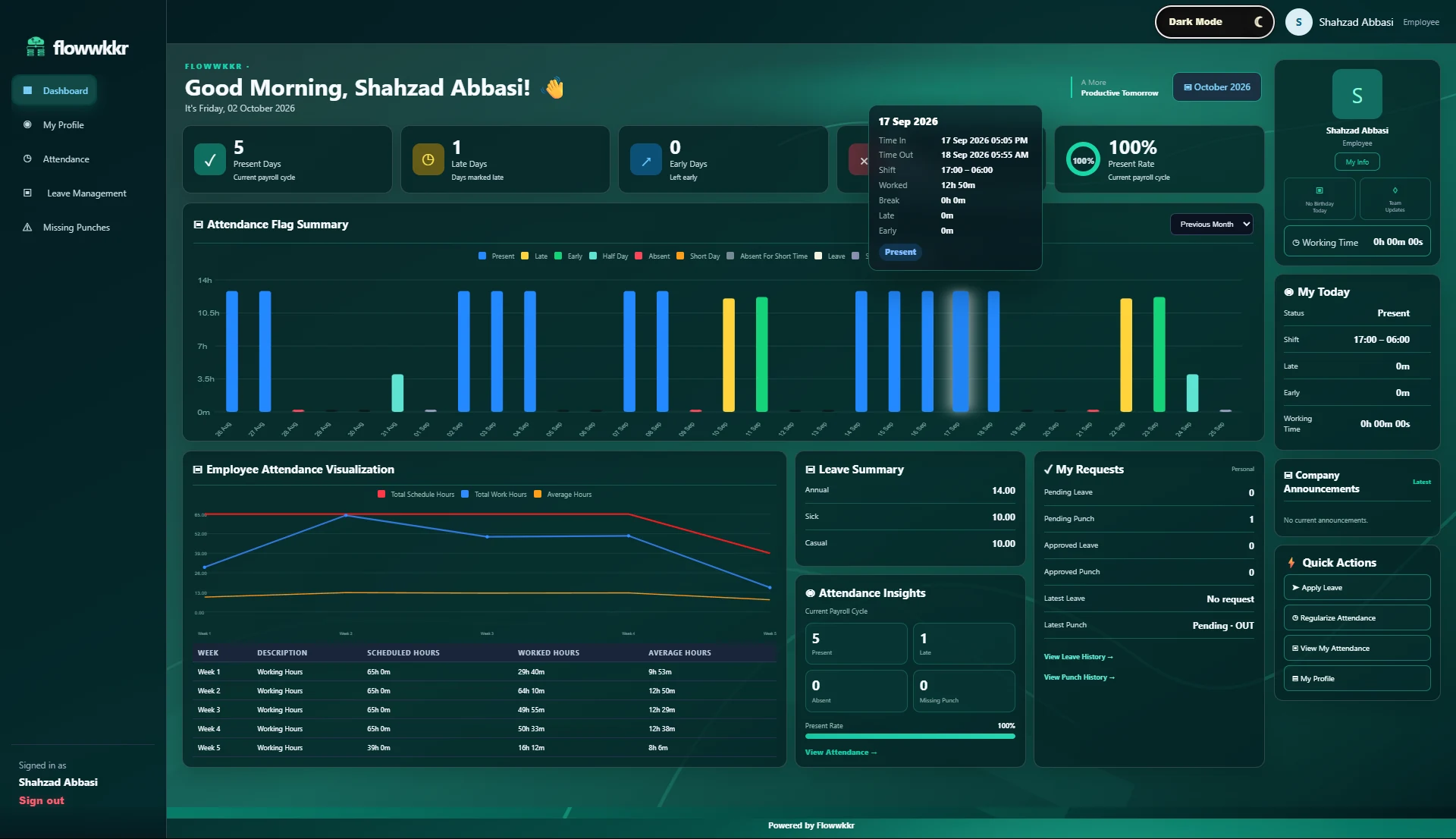
The whole shift window belongs to one attendance record, across the date boundary, so hours are never split.
A shift starting at 22:00 and ending at 06:00 crosses midnight. Most attendance systems treat that as two calendar days and report a punctual night supervisor as late one day and absent the next. This is the specific failure Flowwkkr was built to remove.
Explore the product area in more detail and see how it fits into the wider Flowwkkr HR workspace.
The whole shift window belongs to one attendance record, across the date boundary, so hours are never split.
A punch at 00:30 is a midpoint, not a missing check-in on a new day.
An approved night shift is deducted as leave rather than reported as an absence.
A shift starting on the last day is counted in that month in full, so hours are never double counted or lost.
Standby, split shifts and long cycles each have a defined, consistent handling.
Give us your real shift times and check an overnight example end to end, including across a month boundary.
Overnight shifts break attendance software in a specific, predictable way. A shift that starts at 22:00 and ends at 06:00 crosses midnight, and most attendance systems treat that as two calendar days. The result is a night-shift supervisor who worked eight hours being reported as late on one day and absent on the next, and a payroll run that nobody trusts. This is the problem Flowwkkr was built to solve.
The employee did nothing wrong and was paid as though they had not turned up. This is the scenario that destroys trust in an attendance system, and it is why night-shift workers in particular tend to be the loudest critics of whatever software their site uses.
| Time | Event | Calendar-day system | Shift-aware system |
|---|---|---|---|
| 21:55 Tue | Punch in for the 22:00-06:00 shift | Late arrival, 5 minutes | On time, 5 minutes early |
| 00:30 Wed | Still working | New day, no check-in recorded | Midpoint of the same shift |
| 06:10 Wed | Punch out | Absent all day — no check-in exists | Shift complete, 15 minutes overtime |
| Result | Payroll input | Late 1 day, absent 1 day, 0 working hours | 1 working day, 8h 15m, 15m overtime |
Any attendance product that gets these three wrong will get night shifts wrong, regardless of how good its reporting looks. They are worth testing explicitly during a demo, with your own shift times.
A fixed night shift is the easy case. Real rosters are not fixed, and each pattern introduces a different edge case that the attendance calculation has to handle.
| Pattern | The edge case | Correct handling |
|---|---|---|
| Fixed nights, 22:00-06:00 | Shift crosses midnight | One attendance record per shift |
| Rotating two-shift cycle | Shift type changes weekly | Rostered shift drives the calculation each cycle |
| 12-hour shifts, 08:00-20:00 and 20:00-08:00 | Both may cross midnight | Each shift counted once, not split |
| On-call standby | Staff present but not working | Standby tracked separately from working time |
| Split shift with a long break | Punch gap mid-shift | Break recognised, not a missing punch |
| Month-end shift ending on day 1 | Attendance spans two months | Attributed to the shift start, consistently |
A night shift starting on the last day of the month ends in the next one. Whoever prepares payroll has to decide which month the hours belong to, and if the answer is not consistent the same shift is counted twice or not at all.
Flowwkkr attributes an entire shift to the shift start date, so a month boundary never splits a working day. The rule is fixed in advance rather than decided by whoever runs the payroll that month, which removes the most common source of month-end argument.
Night-shift handling is easy to verify and easy to fake, so it is worth testing with data you control rather than accepting a demonstration.
Because most systems calculate attendance per calendar day. A shift running 22:00 to 06:00 crosses midnight, so the check-in lands on one date and the check-out on the next. The system sees an employee who arrived late and then failed to check in the following day, and reports absence for hours actually worked.
Attendance is calculated against the rostered shift period, not the calendar date. The shift owns the whole attendance window across the date boundary, so a 22:00 to 06:00 shift is recorded as one complete working day with correct working hours and overtime.
Flowwkkr attributes the entire shift to the shift start date. A shift starting on the last day of the month is counted in that month in full, so month boundaries never split a working day or count the same hours twice.
Yes. Leave is matched against the rostered shift, so an employee on sanctioned leave for a night shift is deducted as leave rather than reported absent, and their balance updates correctly.
Yes. The rostered shift drives the calculation for each cycle, so rotating night and day patterns are calculated correctly without manual correction. Recurring roster management is available as a licensed module.
Bring your device model, shift pattern and employee count. We will confirm fit on a private 2-hour demo.
Request a private 2-hour live demo and explore the HR workflow.